Rendering Carlton
Roof-Water Stains or Coating Failure? | Carlton Guide
A dark streak below a gutter can make a newly decorated wall look old surprisingly quickly. It is tempting to clean the mark or cover it with another coat, but the mark alone does not tell you whether the coating has failed. Water may be reaching the surface from a nearby defect, or a different problem may be involved. A useful inspection starts by recording the pattern and the surrounding details without deciding the cause in advance.

On this page
Start with the position of the mark
Look at where the discolouration begins. Is it immediately below a gutter joint, an overflow, a sill corner or the top of a pipe? Does it follow a narrow line or spread across a broad sheltered area? Photograph the whole elevation as well as the stain. The wider view may show a relationship that disappears when the image is cropped tightly around the worst patch.
Record when you first noticed it and whether it changes after rainfall. If you have earlier photographs, keep the dates with them. Do not climb to inspect fittings yourself; observations from a safe position can help a competent contractor decide what needs access. The purpose is to improve the information available for a survey, not to replace that survey with a confident diagnosis based on a photograph.
A stained surface may still be attached securely
Colour change and physical detachment are different conditions. A dirty or algae-marked area may remain sound, while a comparatively clean area may have lost attachment beneath the surface. The inspection should assess the finish as a material system, not just judge its colour. Ask what evidence supports the proposed treatment and whether the background needs any additional investigation.
If the surface is loose, render repairs may be required before decoration is considered. If it is sound and the issue is superficial, an appropriate cleaning or coating method may be relevant. The distinction matters because replacing a sound elevation can be unnecessary, while coating a defective one leaves the underlying problem in place. The visible mark is a starting point, not a complete specification.
Inspect the water-handling detail above it
Rainwater fittings should be considered alongside the wall finish. A joint that leaks during heavy rain may be dry when a contractor arrives. Photos or notes from different conditions can help, provided they are taken safely. The inspection may need to establish whether a gutter, pipe, roof junction or sill is concentrating water onto the wall in a way the finish was not intended to receive.
If a defect is found, identify who will repair it and when. A renderer may not be the person responsible for every roof or drainage component. The project needs coordination rather than an assumption that the surface contractor will quietly sort out all adjacent work. Repairing the water source after applying a new finish may also damage or dirty that finish unnecessarily.

| Observation | Question for inspection |
|---|---|
| Mark below a gutter joint | Is water escaping there during rain? |
| Surface discoloured but apparently intact | Is cleaning or coating appropriate after assessment? |
| Area visibly detached | What is the sound repair boundary? |
| Same mark returns | Was the source established and corrected? |
Do not treat water repellency as a substitute for drainage
Product descriptions can be misunderstood. A finish with water-repellent characteristics still needs the building's roof, gutters and openings to work properly. It should not be expected to compensate for a concentrated leak indefinitely. The relevant technical question is whether the proposed system suits the background and exposure, with correctly resolved details, not whether its marketing name sounds waterproof.
The silicone-rendering page describes the finishing material within a complete system. For monocouche, the specific product and surface treatment matter too. Keep those choices separate from repairing an obvious defective fitting. Changing the render family without addressing the source of abnormal wetting may simply create a newly coloured version of the same maintenance problem.
Check whether cleaning is appropriate
The cleaning method should suit the material and the type of marking. Aggressive pressure washing or an unsuitable chemical can damage a finish or surrounding components. Ask for the manufacturer's care guidance where the product is known. Where it is not, a competent assessment and a suitable trial may be needed before treating a large area.
Cleaning also needs to be judged after the relevant conditions have stabilised, rather than immediately covering a wall that has just been saturated. The coating or repair specification should set the requirements for the next stage. Avoid using a fixed waiting period taken from an unrelated product as a universal rule. Different backgrounds, conditions and treatments may require different decisions.
Repainting changes colour, not the source of wetting
If the existing surface is suitable, render recolouring can provide a different appearance. That proposal should include preparation, any necessary repair and a compatible coating. It should also explain what happens to the water source identified during the inspection. A quotation that mentions only the paint colour has not answered why the original mark appeared.
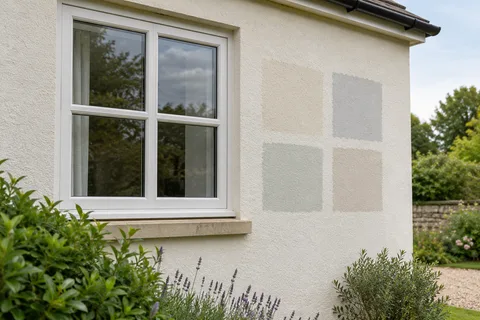
Ask whether the repaired area will remain visibly different in texture even after coating. A new colour can unify the tone without flattening an uneven patch. If appearance is important, assess a representative sample and agree the extent of the decorated area. The sample-lighting article explains why a patch should be checked in more than one lighting condition before assuming it blends successfully.
Traditional walls need a compatible treatment
On an older masonry wall, existing mortars and coatings may affect drying and the consequences of a leak. A dense new coating is not automatically a suitable way to deal with discolouration. The lime-rendering guide explains why material compatibility belongs in the assessment. The inspection should still identify any concentrated water source; lime is not a substitute for maintaining gutters or resolving ground-level problems.
Where an old hard covering is being considered for removal, assess the possible damage caused by removal as well as the benefits. It may be necessary to investigate a small area before a larger decision is made. The fact that a wall has a stain does not, by itself, establish that stripping every coating is justified or that exposed masonry will provide a better outcome.
Agree an observation or repair record
Keep the original photographs, the inspection findings and the work carried out. Record product details and the date of any fitting repair. If the stain returns, this helps distinguish an unresolved source from a new defect or ordinary surface soiling. A simple record is often more useful than a folder of close-up images with no dates or locations.
Where the cause remains uncertain, ask what further evidence is needed and who is best placed to obtain it. That may involve another trade or an appropriate building professional. A contractor should not need to invent a confident answer merely to complete a quotation. It is better for the scope to identify a genuine investigation stage than to promise a cosmetic treatment will settle every possible cause.
Choose the next step according to the finding
The outcome may be a gutter repair and cleaning, a local render repair, a compatible coating or a more substantial wall project. These are distinct pieces of work. Our wall rendering page covers replacement of a defined face, while the Carlton homepage brings the other services together. Use the inspection findings to choose among them rather than deciding on a service first and making every symptom fit it.
When reviewing a proposal, look for a direct connection between the observed problem and the work described. It should be clear what addresses the source, what restores the damaged material and what changes the appearance. That explanation is more useful than a broad promise to make the wall weatherproof, particularly when the original problem may have started with a small fitting above it.
Common questions
Does a recurring stain prove the render product is defective?
No. The product, background and surrounding water-handling details need assessment. A local leak may repeatedly wet an otherwise suitable finish. Keep the history and photographs so the inspection can distinguish the visible symptom from its possible causes.
Should I choose a more water-repellent finish immediately?
First establish why the area is being wetted and whether the existing material has failed. A change of finish does not replace repairing a defective gutter or junction. Product selection should follow the building assessment and the complete proposed specification.
See housing and planning information for Carlton and nearby places, including the source and geography behind each figure.