Rendering Carlton
Silicone Rendering Carlton | Colour, Grain & Preparation
A silicone finish can give an exterior a consistent coloured texture without making every wall look perfectly flat or featureless. The result depends on the specified build-up underneath, the grain chosen and the way the finish is applied across each panel. For silicone rendering in Carlton, compare a complete wall specification rather than treating the decorative coat as a standalone cure for an old surface.

On this page
The visible coat is one part of the system
The term silicone render generally describes a thin decorative finishing material within a prescribed system. What sits beneath it depends on the background and the manufacturer's requirements. The quotation should identify the base preparation, any required reinforcement, primers and finishing product. Components should be compatible with the selected system. A collection of familiar brand names is not a substitute for a written build-up that is appropriate to the wall.
Ask whether the proposal is for render alone or the finish on an insulated facade. The two can look similar when complete, but the design and extent of work differ substantially. External wall insulation involves its own fixing, opening and edge details. It should not be implied by a silicone-render description, and a decorative silicone layer should not be presented as providing the same thermal function as insulation.
- Sound background A background accepted by the specified system. Keeping old render requires a system-specific assessment of its bond and condition.
- Beads Corner, stop and base beads set the edges and straight lines.
- Basecoat with mesh Glass-fibre mesh embedded in the basecoat resists cracking.
- Primer Where the system requires it, tinted towards the finish colour.
- Silicone finish A thin, through-coloured, water-repellent coat that forms the texture.
Wall on the left, finish on the right. Not to scale: coats, thicknesses and primers follow the chosen manufacturer’s system and the condition of the wall.
Start with a surface that can carry the work
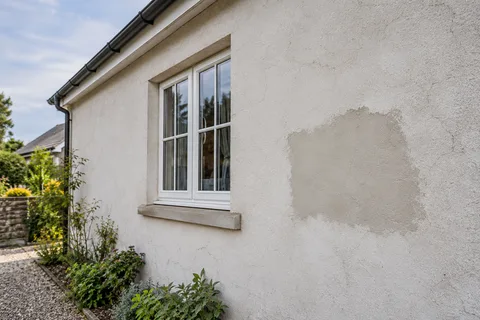
Existing render may be sound in some places and detached in others. Paint may have poor adhesion or conceal a weak layer beneath. Before a new build-up is chosen, establish what is being retained and why it is suitable. Where necessary, the contractor or system supplier should define testing and preparation. The relevant question is whether the full retained background can support the proposed system, not whether the top surface looks clean from the pavement.
Where defects are isolated, render repair may form part of the preparatory work. More extensive failure can change the scope to removal and replacement. It is useful to separate these possibilities in the quotation, particularly if access is needed to inspect high areas. Do not accept a broad promise that a thin finish will disguise deep irregularities or prevent existing structural movement from affecting the new surface.
Choose the grain before judging the colour
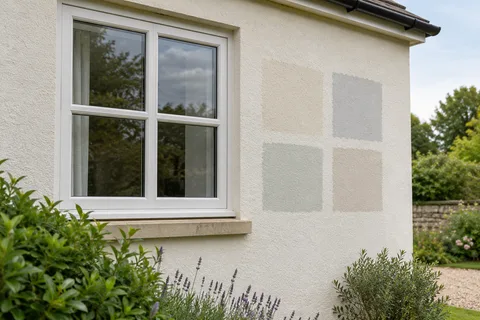
Two samples with the same colour reference can look different when their textures differ. Grain affects how light catches the surface and how prominent the finish appears at close range. Put the intended texture beside window frames, a retained brick area and the proposed trim colour. If the facade includes a broad gable, consider how the sample will read over that larger area rather than judging it only beside the front door.
The article on samples in direct and diffuse light explains why a shaded view is worth comparing with sunlight. Photographing a sample is useful for keeping a record, but a camera can change the apparent colour. Keep the approved physical sample available where possible and record the exact product, colour and grain specification, so that later ordering does not rely on a loosely described shade.

| Component | Required information |
|---|---|
| Retained background | Condition and preparation evidence |
| Base and reinforcement | Specified materials and junction treatment |
| Decorative coat | Product, colour and grain |
| Maintenance | Suitable cleaning and later coating guidance |
Set panel boundaries that suit the building
Corners, changes in plane and openings help divide a wall visually. Planned stop positions also help establish how application will be organised. Discuss where the work changes direction and where joints or profiles are required by the design. A facade should not acquire an arbitrary visible break simply because the extent of one working section was never discussed.
Where the new finish meets a neighbour's wall or retained masonry, the edge should belong to a defined detail. That may involve a profile, a return or another designed junction. The selected system's requirements still apply at those edges. Our single-wall rendering page looks at these boundaries in more detail, including narrow side passages and changes in ground level that may be difficult to appreciate from a front photograph.
Deal with water sources before changing the surface
A dark mark below a gutter joint or overflow should be investigated before a new decorative coat is specified. Persistent wetting from a local defect is different from ordinary weathering. Silicone terminology is sometimes taken to mean that a wall no longer needs drainage or maintenance. It does not justify leaving a leaking fitting in place or covering a poorly resolved sill junction with a fresh textured layer.
Arrange any necessary gutter, pipe or sill work in the right sequence. Where fittings are temporarily removed, establish how the surface beneath them will be prepared and how they will be fixed back without damaging the completed finish. The roof-water staining article sets out useful observations to share with a surveyor. It does not replace an inspection of the actual source.
Application conditions need a real contingency
The weather at the wall can matter as much as the headline forecast. Direct sun, wind, rainfall and low temperatures may affect the permitted application and curing conditions of the specified products. Follow the current manufacturer's instructions, with suitable protection and competent site planning. A promise to finish on a particular day should not override those conditions merely because the scaffold has already been arranged.
Ask how the programme handles unsuitable conditions, who decides whether work proceeds and how protected areas remain secure during a pause. No local average tells us how many workable days your project will have. Discuss the protection and rescheduling arrangements before work starts. The condition of the actual wall and the product instructions govern that decision.
Compare future care as well as the new appearance
Ask for cleaning guidance that belongs to the selected finish and for advice on any later coating. Aggressive cleaning can be unsuitable, so do not assume that every pressure-washing method is acceptable. Keep the finish reference and the installer or supplier's written care information. If a mark reappears in the same place, inspect the cause before repeating cleaning.
For a sound existing surface whose appearance simply needs updating, recolouring may be a separate option. For a mineral scraped finish, compare monocouche. The Carlton rendering homepage sets those routes beside lime, repairs and removal. The choice should leave you knowing what is being applied, what it is being applied to, and what work around the wall is included.
Common questions
Is silicone render the same thing as exterior paint?
It is generally described as a textured finishing material within a render system. The actual product and build-up need to be named. A coating intended to recolour an existing surface is a separate specification and should not be confused with a complete new render system.
Does a silicone finish mean insulation is included?
No. A similar-looking finish can be used in different build-ups. If insulation is proposed, the quotation must identify it and include the relevant design, fixings and interfaces. A decorative surface description alone does not establish thermal performance.
See housing and planning information for Carlton and nearby places, including the source and geography behind each figure.