Rendering Carlton
Render Repairs Carlton | Cracks, Loose Areas & Patches
A render repair should deal with the defect, not just make it less visible for a few weeks. Cracks, detached patches and staining can have different causes, even when they appear on the same wall. For render repairs in Carlton, start with the location, history and condition of the affected area. The assessment should then explain what needs investigation, what can be repaired locally and when a larger defined section deserves attention.

On this page
Describe the symptom without guessing the cause
Record where the problem occurs and whether it has changed. A crack beside a window, a patch that sounds hollow and a stain beneath a pipe are different observations. Include dates if you have older photographs. If a repair has failed before, keep any information about the previous material and method. That history may be more useful to the surveyor than a general description that the whole wall is bad.
Photographs should show the defect close up and in the context of the elevation. Avoid relying on an extreme close-up that hides its position. Our survey photograph guide explains what images can and cannot establish. They can help organise an inspection, but they cannot reliably establish adhesion, hidden moisture paths or the condition of masonry behind the finish.
- Map the damage Tapping finds hollow areas; cracks and their likely cause are noted.
- Cut back Failed render is cut out to a sound edge, usually squared off.
- Fix the cause Leaking gutters, sills without drips or render below the DPC are dealt with.
- Rebuild in coats Using a material compatible with the surrounding render and masonry.
- Blend the finish Texture is matched; colour may need a coating over the wider area.
The usual order of work. The survey and the chosen products decide the actual steps.
Separate staining from physical failure
A discoloured surface may still be attached securely, while a fairly clean patch may be loose. The assessment should distinguish those conditions. Check visible rainwater fittings and the relationship with sills, copings and roof edges. If a concentrated source of water is involved, treating the surface without addressing that source may leave the same problem recurring.
The article on roof-water stains and coating failure sets out useful questions. Cleaning, coating and repair have different purposes. A new colour cannot provide the missing support beneath detached render, and breaking off an entire sound elevation is not the automatic answer to every mark. The proposed work should follow the condition found rather than a preference for one service.
Decide how far a patch should extend
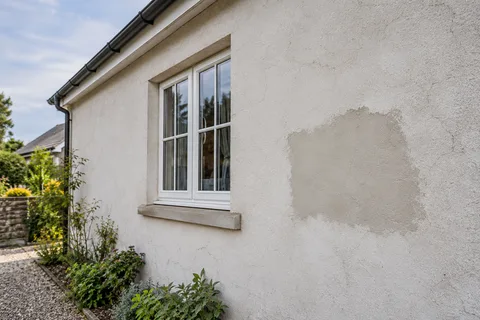
A repair needs a suitable boundary and a sound surrounding background. Its extent may become clearer during careful opening-up. Ask how the contractor will establish that boundary and report additional defects. The aim is to avoid leaving weak material immediately around a newly finished patch, while also avoiding unnecessary removal of sound areas.
Appearance is a separate decision. A technically limited repair can still remain visible because the existing surface has aged or uses an unidentified texture. The owner should understand that before approving the scope. Finishing a larger panel may reduce the visual interruption, but it increases the work and should be explained as an option. The single-elevation guide helps compare a local patch with a whole defined face.

| Observation | What should be established |
|---|---|
| Recurring crack | History, construction and whether further assessment is needed |
| Detached patch | Sound repair boundary and background condition |
| Dark streak | Surface condition and possible water source |
| Visible earlier repair | Compatibility, texture and desired appearance extent |
Choose repair materials that belong with the wall
The original finish may be a mineral render, a thin-coat system, a traditional lime material or a layered combination. Do not assume that a general exterior filler is suitable for every defect. The repair specification should account for the retained material, background and intended decoration. Where the system is known, manufacturer guidance can help establish compatible components and treatment.
For older masonry, lime-render compatibility may be central to the decision. A hard patch in a softer wall can behave differently from the surrounding material. For a modern system, the reinforcement or base layers may need a defined repair detail rather than a cosmetic skim. If the material is unknown, identify the assessment required before promising an exact product or a permanent result.
Repeated cracks deserve a clear investigation route
A crack that returns after filling should not simply receive another identical treatment without review. Record its pattern, any changes and the construction around it. Existing movement joints, altered openings and junctions between additions can be relevant. Where structural movement is suspected, suitable professional advice may be needed before decorative repairs are specified.
This page does not diagnose a building from crack width or photographs. Ask the inspecting professional to explain what is established, what remains uncertain and whether monitoring or further investigation is required. The proposed repair should follow that conclusion. Reinforcement within a render system is not a blanket guarantee that movement in the building will never appear in its surface.
Make the colour and texture decision explicit
A new patch may differ in grain, colour or weathering even when the original product is identified. Approve a sample where appearance matters and decide what degree of visibility is acceptable. Look at the trial in changing light. A patch that seems unobtrusive in diffuse daylight may show a different relief when low sunlight crosses the elevation.
If the surface is otherwise suitable, recolouring might form part of a wider appearance treatment after repairs. That still needs a compatible coating specification and a suitable background. It should not be used to conceal unfinished preparation. If replacement is chosen, compare silicone and monocouche against the building's needs rather than assuming the patch repair dictates the finish for the whole house.
Write down what happens during the work
The repair scope should include access, protection, removal, preparation, finishing and making good. State whether rainwater or other fittings need to be moved and who is responsible. If loose material is discovered beyond the assumed area, agree how photographs, measurements and approval will be handled. This avoids an argument about whether an extension of the patch was necessary after it has already been covered.
For a building that remains occupied, include the practical arrangements around doors and paths. Where a shop or other workplace is involved, the commercial rendering page considers separation from customers and staff. A small physical repair can still need careful access planning if it sits above an entrance or beside a neighbour's property.
Keep a record that makes the next inspection easier
At completion, photograph the finished repair and retain any images of the exposed background. Record the material, colour and repair date. If the same symptom returns, that record helps distinguish a new problem from a repeated one. Ask what observations should prompt further advice and how the repaired surface should be maintained.
For a house with several unrelated damaged areas, a whole-house survey brief can help organise the work without assuming every wall needs replacement. The Carlton homepage links to the different services so that cleaning, coating, repair and new render remain separate choices. The most useful outcome is a clear explanation of the defect and an appropriate repair scope, not a reassuring phrase that avoids the underlying question.
Common questions
Can a crack be priced accurately from a close-up?
A close-up can show its appearance, but not necessarily its cause or extent. Include a wider view and history, then establish what inspection is needed. A preliminary estimate should keep unverified assumptions visible rather than presenting a photograph as a complete survey.
Will a repair patch be invisible?
That should not be promised generally. Existing weathering, unknown materials and texture differences can leave a visible patch. A sample and a discussion of the finish extent help establish an acceptable result before the repair is approved.
See housing and planning information for Carlton and nearby places, including the source and geography behind each figure.