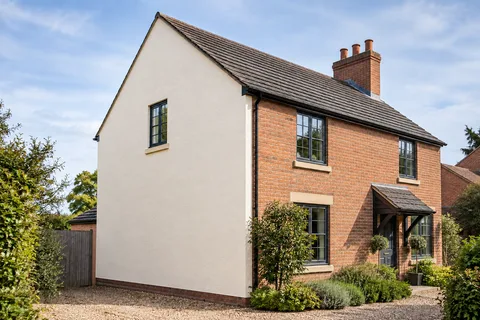
Rendering Carlton
What Render Survey Photos Cannot Establish | Carlton
Photographs are a useful first step when describing a rendering project. They can show the building, proposed work and obvious defects before a contractor visits. They can also create false confidence when a close-up seems to explain more than it actually does. A photograph is a record of visible appearance at one moment. It does not establish how well the layers are attached, what lies behind them or whether a particular system is suitable for the wall.

On this page
Give every close-up a wider view
Start with a full elevation, then show the area of concern in relation to a fixed feature such as a window or downpipe. A final close-up can record the visible defect. This sequence makes the image useful to somebody who has never seen the building. Without it, a contractor may be unable to tell whether a crack is above a doorway, at an extension junction or in the middle of a large uninterrupted panel.
Label the images by elevation and date. If the same area is photographed later, use a similar position where possible. That makes changes easier to discuss. Avoid applying filters or editing away surrounding details. The aim is to communicate the condition and position, not to produce a polished image of the house or make the defect appear more dramatic than it is.
A visible crack does not explain its cause
An image can show a crack pattern, but it cannot by itself establish whether the issue is confined to the finish or relates to something underneath. The surrounding construction, history and condition may be relevant. A recurring crack deserves information about earlier repairs and any observed change. Keep those facts separate from a guessed explanation about settlement, thermal movement or defective workmanship.
The render repair page describes the assessment questions without diagnosing the building remotely. If further professional investigation is appropriate, that should be part of the next step. An online exchange should not end with an unsupported promise that a particular mesh, filler or coating will permanently solve a defect whose cause has not been established.
Attachment is not visible in an ordinary photograph
A surface can look complete while portions are detached from the background. Conversely, an uneven appearance does not prove that the render is loose. Assessing attachment may require appropriate inspection or testing by a competent person. The quotation should identify whether the proposed work assumes sound existing material and what check will confirm that assumption.
This matters for recolouring, where the new coating depends on a suitable retained surface. It also matters when another render system is proposed over existing layers. A photo-based estimate can be useful as an initial conversation, but it should not silently turn a visual assumption into a final specification. State what remains subject to inspection before treating the scope as settled.

| Photographs can show | They cannot alone establish |
|---|---|
| Visible crack position | Cause or hidden extent |
| Stain pattern | Complete moisture path |
| Approximate surface appearance | Exact product composition or colour |
| Visible access obstructions | A safe engineered access arrangement |
Images cannot identify every retained material
Old render, paint and patching can look similar in photographs despite having different compositions. Even a clear image may not identify the binder, coating type or sequence of layers. Product records, previous invoices or a suitable investigation can provide information that appearance alone cannot. If those records exist, share them with the person assessing the work.
For an older building, the distinction can affect compatibility. The lime-rendering guide explains why traditional masonry should not receive a generic modern treatment merely because a photograph resembles a recently built wall. Where hard coatings are considered for removal, a trial may be required to understand both the background and the damage removal could cause. The camera cannot answer those questions in advance.
Staining needs its surroundings and history
A dark patch can have several explanations. Show the roofline, gutters, sills and ground around it, and record whether the appearance changes after rain. A cropped photograph can hide a defective fitting immediately above the mark. It can also make ordinary shade look like discolouration, particularly when one side of the building is in strong sunlight.
The roof-water staining article is useful when preparing observations. Do not undertake unsafe access to obtain a better image. A competent inspection can establish what needs to be examined at height. It is preferable to state that a fitting cannot be seen clearly than to lean into a hazardous position or assume it is sound because it is outside the photograph.
Colour and texture are altered by the image
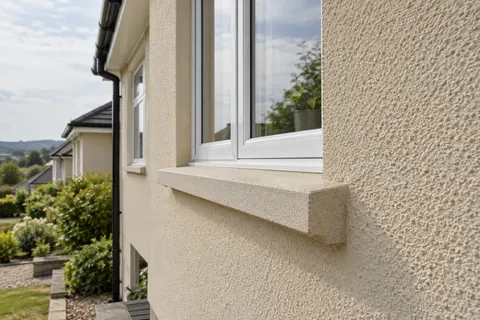
Camera processing, screen settings and lighting affect the appearance of a finish. A sample photographed on a phone may not reproduce its colour accurately on another device. Low sunlight can exaggerate surface relief, while diffuse light can make it look flatter. Neither image is necessarily dishonest; each records different viewing conditions and processing.
Use photographs to compare broad design ideas, then approve the physical material where possible. Our sample-lighting guide explains how to make that approval more useful. Record the product and colour reference alongside the sample. A saved image called “cream finish” is a poor ordering instruction and may become even less useful when the original file is compressed or viewed on a different screen.
Access constraints need more than one angle
A wide-angle lens can make a narrow side passage appear more generous than it is. A frontal view can also hide the slope of a path or the depth of a porch. Include views along the elevation and show obstructions below the work. Where dimensions are useful, provide measured information rather than expecting the contractor to estimate scale from a distorted image.
The article on sloping-site scaffold quotations explains the access brief. Photographs help identify the need for assessment, but they are not an access design. If the project involves external insulation, actual dimensions around boundaries, openings and roof edges are especially important because the finished wall line changes. That cannot be resolved from an attractive elevation photograph alone.
A useful photo pack supports a defined question
Decide what you want the recipient to consider: whether a visit is needed, which investigation may be useful or what information is missing from a proposed scope. Include the intended outcome and any known constraints. A long folder of unrelated images can be less useful than a short labelled sequence that follows the building logically.
For whole-house rendering, include every proposed elevation. For one wall, show its boundaries and the surfaces to remain. If the building is occupied commercially, explain entrances and operating requirements alongside the images. The commercial guide covers those considerations. The photos should support the brief, not force the contractor to infer the entire project from whatever happens to be visible.
Keep provisional conclusions visibly provisional
An initial response may identify likely options, but the final decision should follow the required inspection and specification. Ask which assumptions remain open and what evidence will settle them. That helps distinguish a preliminary estimate from a confirmed scope. It also gives a sensible explanation if the proposal changes after the wall is examined rather than treating every revision as an inconsistency.
Return to the Rendering Carlton homepage to compare removal, repair, coating and new render once the condition is clearer. Good photographs can save time by making the first conversation specific. Their value comes from showing what can be seen and making the missing information easier to identify, rather than pretending the camera has carried out a full building survey.
Common questions
Is a photo-based estimate useless?
No. It can help identify likely scope and the information needed next. Its assumptions should remain clear. The problem arises when a preliminary visual estimate is treated as a confirmed specification despite unresolved background, access or material questions.
What is the most useful way to label images?
Use the elevation, date and a clear location reference. Pair each detail with a wider view so another person can find it on the building. Keep unedited originals where possible; filtered or heavily compressed versions may obscure useful information.
See housing and planning information for Carlton and nearby places, including the source and geography behind each figure.